
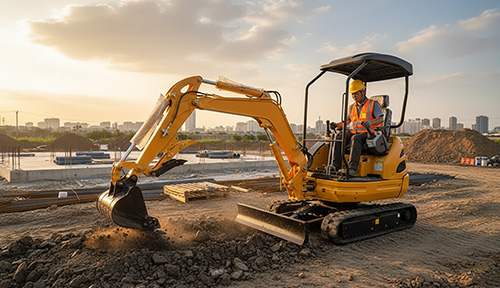
Choosing the right mini excavator is not just about picking a popular model or the cheapest option. A suitable mini excavator can significantly improve work efficiency, reduce fuel costs, and enhance safety on-site. Whether you are working in landscaping, small municipal construction, or residential projects, selecting the right machine depends on your specific working conditions and requirements.
1. Understand the Types of Mini Excavators
1.1 Conventional Mini Excavator
Conventional mini excavators are ideal for general excavation tasks and can work well in confined spaces. They are widely used in landscaping, foundation digging, and small-scale construction.
1.2 Zero-Tail Swing Mini Excavator
Zero-tail swing excavators are designed to operate safely in narrow spaces because the counterweight does not extend beyond the track width. This type is perfect for urban projects, indoor construction, and garden landscapes.
2. Key Factors to Consider
2.1 Operating Weight
The operating weight determines the machine’s stability and digging strength. For example:
- 1.5–2.0 tons: Suitable for small landscaping, trenching, and small foundations.
- 2.5–3.5 tons: Suitable for small municipal works and medium foundation projects.
- 4–6 tons: Suitable for road construction, small demolition, and larger projects.
2.2 Engine Power
Engine power affects performance and fuel efficiency. Choosing a high-power model can improve digging speed but may increase fuel consumption. It is essential to balance power and economy.
2.3 Digging Depth & Reach
Different projects require different digging depth and reach. For example:
- Landscaping and trenching usually require 2–3 meters.
- Small building foundation may require 3–4 meters.
2.4 Bucket Capacity
Bucket capacity affects loading efficiency. Choose a bucket size that matches your material type (soil, gravel, clay, etc.). Over-sized bucket may increase cycle time and reduce efficiency.
3. Choose the Right Attachments
3.1 Hydraulic Hammer
Ideal for demolition, concrete breaking, and rock breaking.
If your project involves frequent demolition, choosing a hydraulic hammer can save time and labor.
3.2 Auger
Used for drilling holes for fences, trees, and foundation piles.
Suitable for landscaping and agricultural projects.
3.3 Grapple
Perfect for handling logs, waste, and debris.
Ideal for forestry and landscaping.
4. Operating Environment and Work Conditions
4.1 Ground Condition
- Soft soil: choose excavators with wide tracks to reduce ground pressure.
- Rocky ground: choose models with strong digging force and durable attachments.
4.2 Work Space
- Narrow spaces: choose zero-tail swing models.
- Open spaces: conventional models are acceptable.
4.3 Noise and Emission Requirements
Some urban areas require low noise and low emission machines. Consider choosing models with:
- Noise reduction systems
- Tier 4 / Stage V engine compliance
5. Cost Considerations
5.1 Initial Investment
A higher-end model usually has better performance and durability, but the initial cost will be higher.
5.2 Operating Cost
Fuel consumption, maintenance, and spare parts are key factors affecting operating cost. A reliable machine with stable performance can save long-term cost.
5.3 Resale Value
Some brands have higher resale value. Choosing a well-known model can bring better resale value in the future.